
A Response to Misrepresentations of the Catholic Faith
An open reply to Isaiah Saldivar and others who share similar claims online

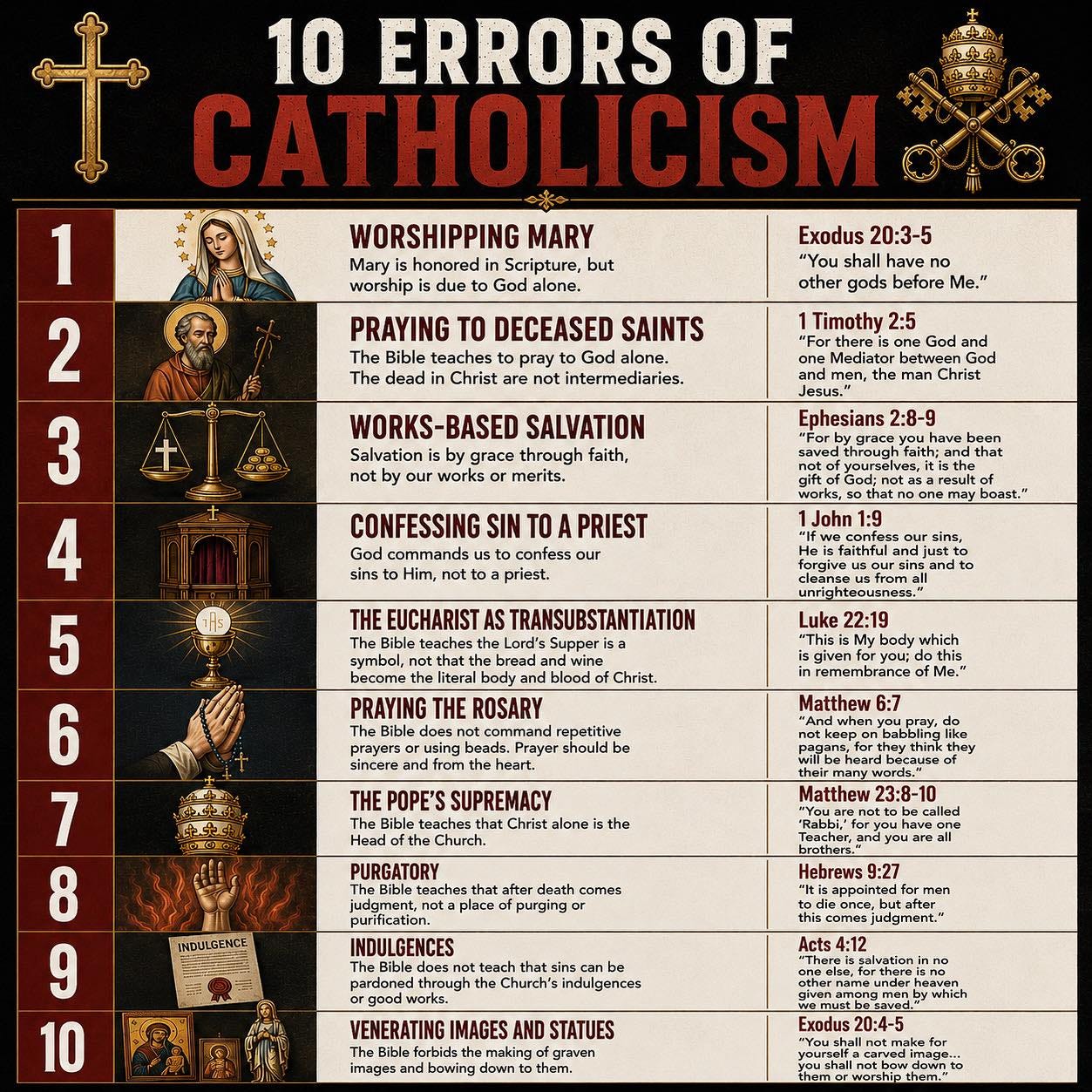
I have no idea who Isaiah Saldivar is. I just saw a post of his suggested by Facebook that misrepresents the Catholic faith and needs a sincere response, as many of his followers sadly believe that post. I have also seen many former Catholics who follow his page agreeing with the statements and cheering him on, which is heartbreaking. Jesus is Truth, and so we should not avoid telling people the truth and pointing out when others are misrepresenting the beliefs of billions of Christians. Below is a response to him, and to others like him out there.
Most of these objections come from misunderstandings of what the Catholic Church actually teaches. Here is a clear response to each, using Scripture and official Catholic sources such as the Catechism of the Catholic Church (CCC).
1. “Worshipping Mary”
Catholics do not worship Mary. The Church has always distinguished worship, which is given to God alone, from honor, which is given to Mary and the saints. CCC 971 says Mary’s veneration “differs essentially from the adoration” given to God. Scripture itself honors Mary: in Luke 1:48 she prophesies, “From now on all generations will call me blessed,” and Elizabeth, filled with the Holy Spirit, calls her “blessed among women” (Luke 1:42). Honoring is not worshipping. We honor our parents (Exodus 20:12) without making them gods.
2. “Praying to Deceased Saints”
“Praying to” in older English simply means “asking” (as in “I pray thee”). Catholics ask saints to intercede, just as you would ask a friend to pray for you. And the saints are not really dead. Jesus said, “He is not the God of the dead, but of the living” (Matthew 22:32). Hebrews 12:1 calls them a “great cloud of witnesses,” and Revelation 5:8 shows them offering the prayers of God’s people before His throne. 1 Timothy 2:5 says Christ is the one mediator, and Catholics agree. But just verses earlier (1 Timothy 2:1-3), Paul commands us to intercede for one another. Asking a Christian in heaven to pray for us does not violate Christ’s mediation any more than asking a Christian on earth does.
3. “Works-Based Salvation”
This is simply not what the Catholic Church teaches. The Council of Trent formally condemned the idea that we can earn salvation by our own works without grace. CCC 1996 says, “Our justification comes from the grace of God,” and CCC 2010 teaches that we cannot merit the initial grace of salvation. Catholics believe salvation is by grace through faith, and that genuine faith produces works, exactly as James 2:24 says: “a man is justified by works and not by faith alone.” Ephesians 2:8-9 (cited in the image) is followed by verse 10: “we are his workmanship, created in Christ Jesus for good works.” Jesus Himself made works essential to judgment in Matthew 25:31-46.
4. “Confessing Sin to a Priest”
Scripture actually commands this. In John 20:21-23, Jesus breathed on the apostles and said, “Receive the Holy Spirit. If you forgive the sins of any, they are forgiven; if you retain the sins of any, they are retained.” For the apostles to forgive or retain sins, they had to hear them. James 5:16 says, “Confess your sins to one another.” Matthew 18:18 gives the Church authority to bind and loose. The priest does not forgive by his own power. God forgives through the ministry Christ established (CCC 1441-1442). 1 John 1:9 affirms God’s faithfulness to forgive; it does not rule out the means He chose.
5. “The Eucharist as Transubstantiation”
Jesus’ own words are remarkably literal. In John 6:51-66, He says, “My flesh is real food and my blood is real drink.” When His disciples objected, He did not soften the teaching. He repeated it more forcefully, and many left Him over it. If it were only symbolic, He could easily have clarified. At the Last Supper He said, “This is my body,” not “this represents.” Paul confirms it in 1 Corinthians 11:27-29: anyone who eats unworthily is “guilty of profaning the body and blood of the Lord.” You cannot be guilty of profaning a symbol. The earliest Christians, such as Ignatius of Antioch around 107 AD and Justin Martyr around 150 AD, all taught the real presence, long before any council “invented” it.
6. “Praying the Rosary”
Matthew 6:7 condemns vain repetition done to be heard for many words, not repetition itself. Jesus repeated the same prayer three times in Gethsemane (Matthew 26:44). Psalm 136 repeats “His steadfast love endures forever” 26 times. In Revelation 4:8 the angels eternally repeat “Holy, holy, holy.” The Rosary is meditation on the life of Christ, including His birth, ministry, passion, and resurrection, using the rhythm of repeated prayers (the Hail Mary is almost entirely Scripture from Luke 1:28 and 1:42) to focus the mind on the Gospel. It is biblical meditation, not empty babbling.
7. “The Pope’s Supremacy”
In Matthew 16:18-19 Jesus told Peter specifically, “You are Peter, and on this rock I will build my church… I will give you the keys of the kingdom of heaven.” The keys image comes from Isaiah 22:22, where they represent a steward’s delegated authority, an office passed on, not a one-time role. Peter is listed first in every list of the apostles (Matthew 10:2). Jesus told him alone, “Feed my sheep” (John 21:15-17), and prayed specifically for him to “strengthen your brothers” (Luke 22:31-32). Matthew 23:8-10 (cited in the image) condemns seeking prideful titles, yet Paul calls himself “father” of the Corinthians (1 Corinthians 4:15). Christ is the invisible Head of the Church; the Pope is His visible steward on earth.
8. “Purgatory”
Purgatory is not a second chance. It is the final purification of those already saved before entering heaven (CCC 1030-1031). Revelation 21:27 says nothing unclean enters heaven, yet 1 John 1:8 says we still have sin. Something must purify believers who die imperfect. 1 Corinthians 3:13-15 describes a man’s work being tested by fire: “he himself will be saved, but only as through fire.” 2 Maccabees 12:44-46 (in Catholic Bibles, removed by Protestants in the 1500s) shows Jews praying for the dead. Jesus said in Matthew 12:32 that a certain sin will not be forgiven “either in this age or in the age to come,” implying some forgiveness does occur after death. Hebrews 9:27 says judgment follows death, which Catholics fully affirm.
9. “Indulgences”
Indulgences do not forgive sins and have nothing to do with buying salvation. That misunderstanding, along with real abuses in the 1500s, sparked the Reformation, and the Church reformed those abuses at the Council of Trent. An indulgence is the remission of temporal consequences of sins already forgiven (CCC 1471). Think of a child who breaks a window: you forgive him, but the window still needs fixing. The biblical pattern is the same. God forgave David’s sin (2 Samuel 12:13), but temporal consequences remained (verse 14). Numbers 14:20-23 shows the same pattern. Selling indulgences was always against Church teaching, and it cannot be done today.
10. “Venerating Images and Statues”
Just chapters after Exodus 20:4-5, God commands Israel to make graven images: two golden cherubim on the Ark (Exodus 25:18-20), a bronze serpent (Numbers 21:8-9, which Jesus Himself compared to His crucifixion in John 3:14), and carved cherubim, lions, oxen, and palm trees in Solomon’s Temple (1 Kings 6-7). So Exodus 20 cannot forbid all images. It forbids making them to worship as gods. When the bronze serpent later was worshipped, Hezekiah destroyed it (2 Kings 18:4). The issue is worship, not the image. Catholics venerate images the way someone might kiss a photo of a deceased loved one. The honor passes to the person represented, not to the wood or paint (CCC 2132).
A Closing Thought
Most of these objections rest on misunderstandings of what the Catholic Church actually teaches. A fair critique should engage the real teaching as found in the Catechism, not a caricature. Whether someone ends up Catholic, Protestant, or Orthodox, the conversation is much more fruitful when both sides represent each other accurately. For deeper study, the Catechism is available free at vatican.va, and authors like Scott Hahn (a former Presbyterian minister), Trent Horn, and Jimmy Akin have written extensively on these exact questions.